
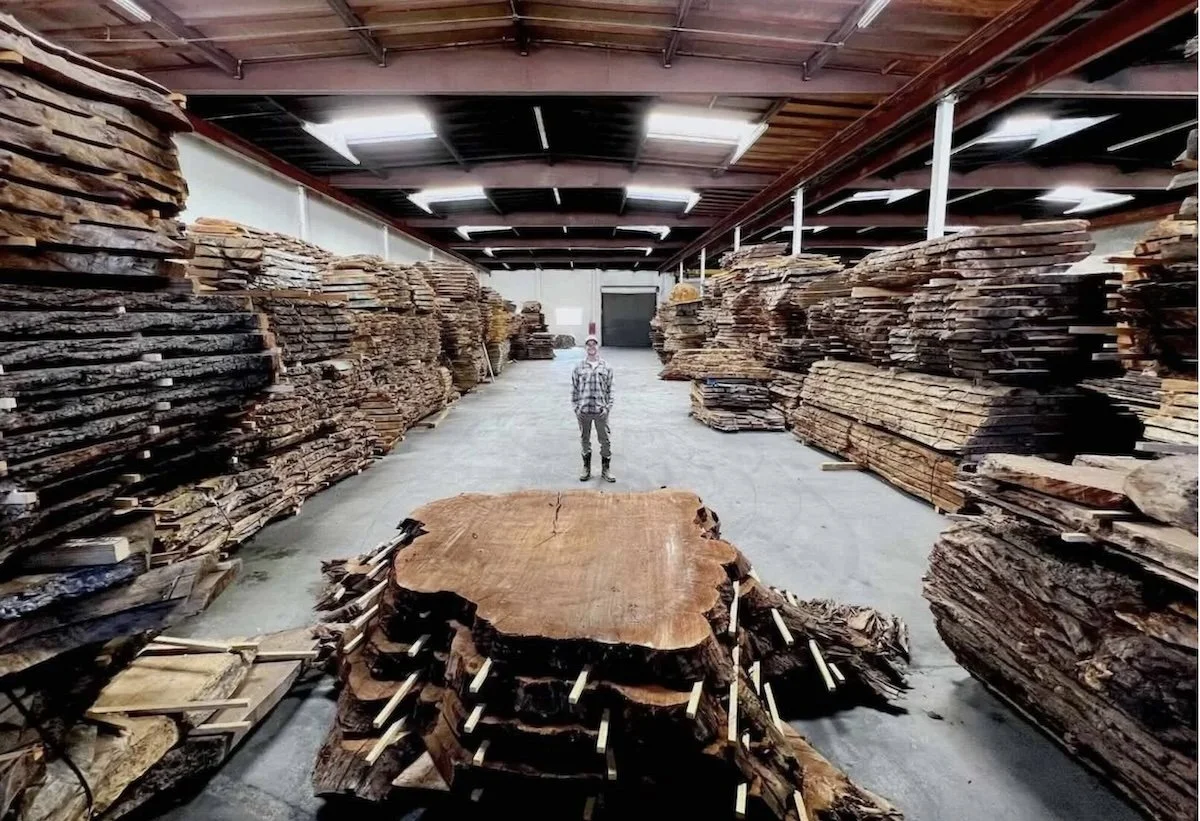
Building a 25-Foot Claro Walnut Live Edge Table for the Hamptons
Most custom dining tables are measured in feet.
Occasionally, a project comes along where the scale changes everything.
One of the largest residential tables I've built is an approximately 25-foot Claro walnut live edge table commissioned for a home in the Hamptons.
At that length, you're no longer simply building a bigger dining table. Sourcing the material, processing the slabs, engineering the support system, transporting the finished piece and getting it into position all become significant parts of the project.
This table is a good example of the type of work I specialize in at Kristopher Kirkpatrick Custom Furniture: large and extra-large custom live edge tables built from exceptional wood slabs.
Here's what goes into creating a table at this scale.
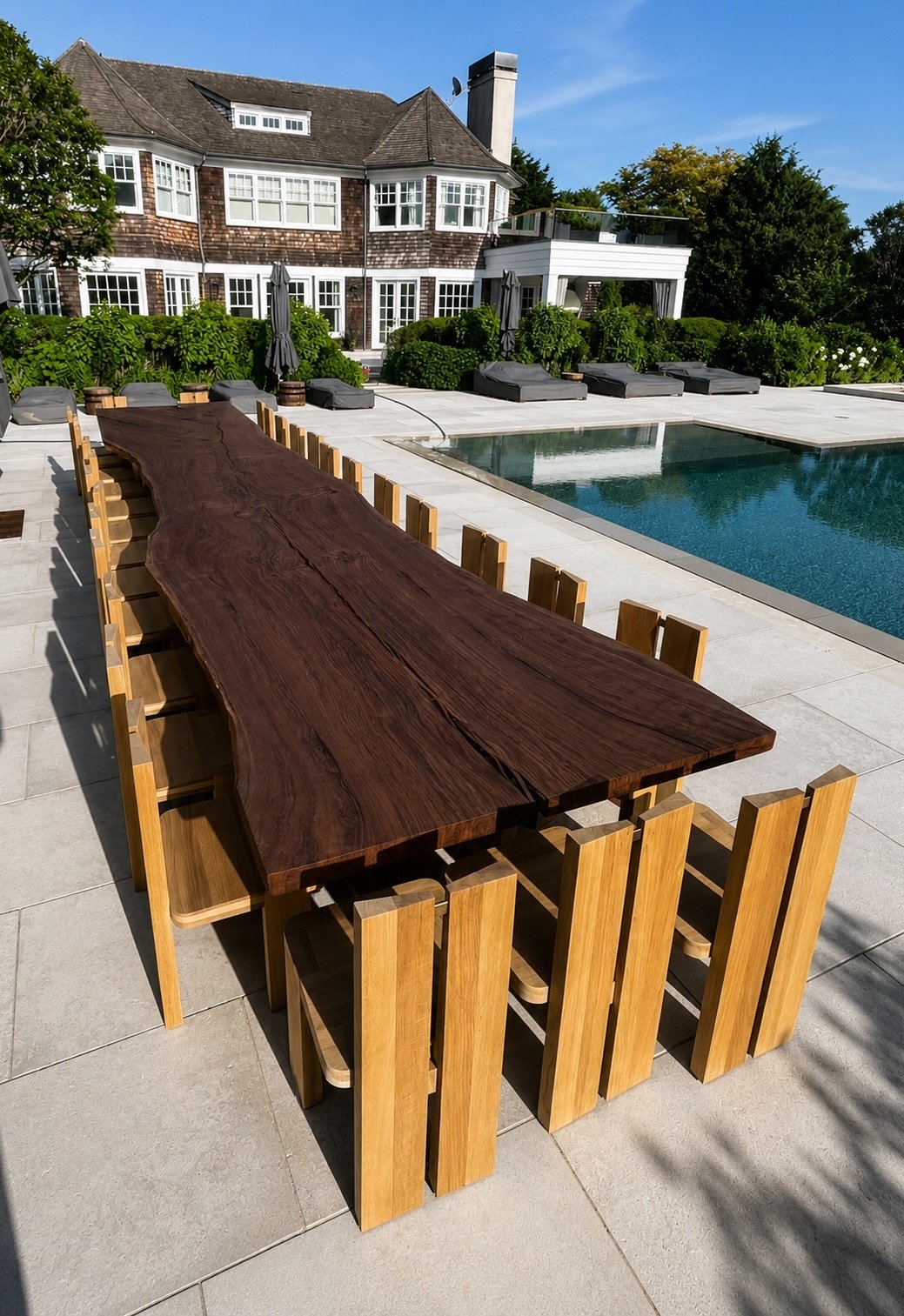
Approximately 25 feet long, this custom Claro walnut live edge table was built for a residential project in the Hamptons.
It Starts With the Right Material
You can't build an extraordinary 25-foot table without extraordinary wood.
As tables become longer, suitable material becomes exponentially more difficult to find. The slabs need sufficient length, but length alone isn't enough.
I'm also looking for appropriate width and thickness, structural integrity, moisture content, grain, color and natural character.
For this project, Claro walnut was an ideal material.
Claro walnut is one of my specialties because exceptional slabs can combine rich chocolate coloration with dramatic grain, curl and figure. On a table this large, those characteristics have enough room to become part of the architecture rather than simply decoration on the surface.
That's ultimately what I want from an oversized table.
At 25 feet, the wood itself should command attention.
Why Extra-Large Slabs Are Difficult to Find
Finding an eight-foot furniture-grade slab and finding material suitable for a 20- or 25-foot table are entirely different challenges.
Trees capable of producing slabs at extreme dimensions are uncommon to begin with.
Then the material has to survive milling and drying while remaining suitable for furniture. Cracks, internal stress, movement, voids and other natural characteristics all need to be evaluated.
I've spent years developing relationships with premium slab suppliers throughout California and the Pacific Northwest. Those relationships are an important part of my ability to build large custom live edge tables.
For oversized commissions, sourcing isn't something that happens after the design is complete.
The available material helps determine the design.
Building at 25 Feet Changes the Process
A table of this size can't simply be treated like an eight-foot dining table.
Everything gets more difficult as scale increases.
The material is heavier. Moving it requires planning and equipment. Surfacing and flattening require large-format capabilities. Stabilization becomes increasingly important. The base has to support an enormous amount of solid wood without visually overwhelming the table.
Even seemingly simple operations become logistical decisions.
How do you safely turn the material over?
How do you move it through the shop?
Where should the bases be positioned so the table is properly supported while maintaining comfortable seating?
How will the finished piece leave the shop?
Those aren't questions you want to answer after construction has already begun.
My shop and workflow are specifically set up to process oversized wood slabs and large-format custom tables, which allows me to take on projects beyond conventional furniture dimensions.
Designing the Base for an Extra-Large Table
The base of a 25-foot table has two jobs.
Structurally, it needs to support the weight and span of the tabletop.
Visually, it needs to disappear.
For this project, multiple substantial wood bases distribute the load beneath the tabletop while preserving the uninterrupted visual impact of the Claro walnut above.
Base placement also affects seating.
A huge tabletop doesn't accomplish much if poorly positioned supports prevent people from comfortably using it.
That's why I design the base system around the actual dimensions and weight of the top rather than selecting a generic base and trying to make it work.
Preserving the Natural Character of Claro Walnut
With exceptional material, I don't want the fabrication process to erase what made the slab special in the first place.
The natural edge, changes in width, grain movement, figure and coloration are all part of the story of the tree.
The goal is refinement without making the material look manufactured.
That's particularly important with a table of this scale.
Perfectly straightening every edge and forcing the piece into a uniform rectangle would remove much of the visual character that justified sourcing extraordinary Claro walnut in the first place.
Instead, the finished table retains the organic movement of the slabs while still functioning as a highly refined piece of furniture.
Moving a 25-Foot Table Across the Country
Building the table is only part of the job.
The project was destined for the Hamptons, thousands of miles from my workshop in Valley Center, California.
For large commissions outside Southern California, transportation and installation need to be considered during the design phase.
Oversized furniture may require custom packaging or crating, freight coordination and a detailed installation plan.
Property access matters too.
Doorways, gates, stairs, landscaping and the final location of the table all need to be understood before an enormous piece of furniture arrives.
With projects at this scale, logistics are part of the craftsmanship.
The table isn't finished when it leaves my shop.
It's finished when it's safely installed where it belongs.
When a Crane Becomes Part of the Installation
Sometimes conventional access simply isn't enough.
For this Hamptons project, installing a table of this scale required coordinating equipment capable of getting the piece where it needed to go.
That included using a crane during the installation.
It sounds extreme for a dining table, but that's exactly the point: once custom furniture reaches these dimensions, installation begins to resemble architectural work.
This is why I plan delivery early when designing extra-large tables.
The dimensions of the table, construction method and base system all need to account for how the piece will ultimately reach its destination.
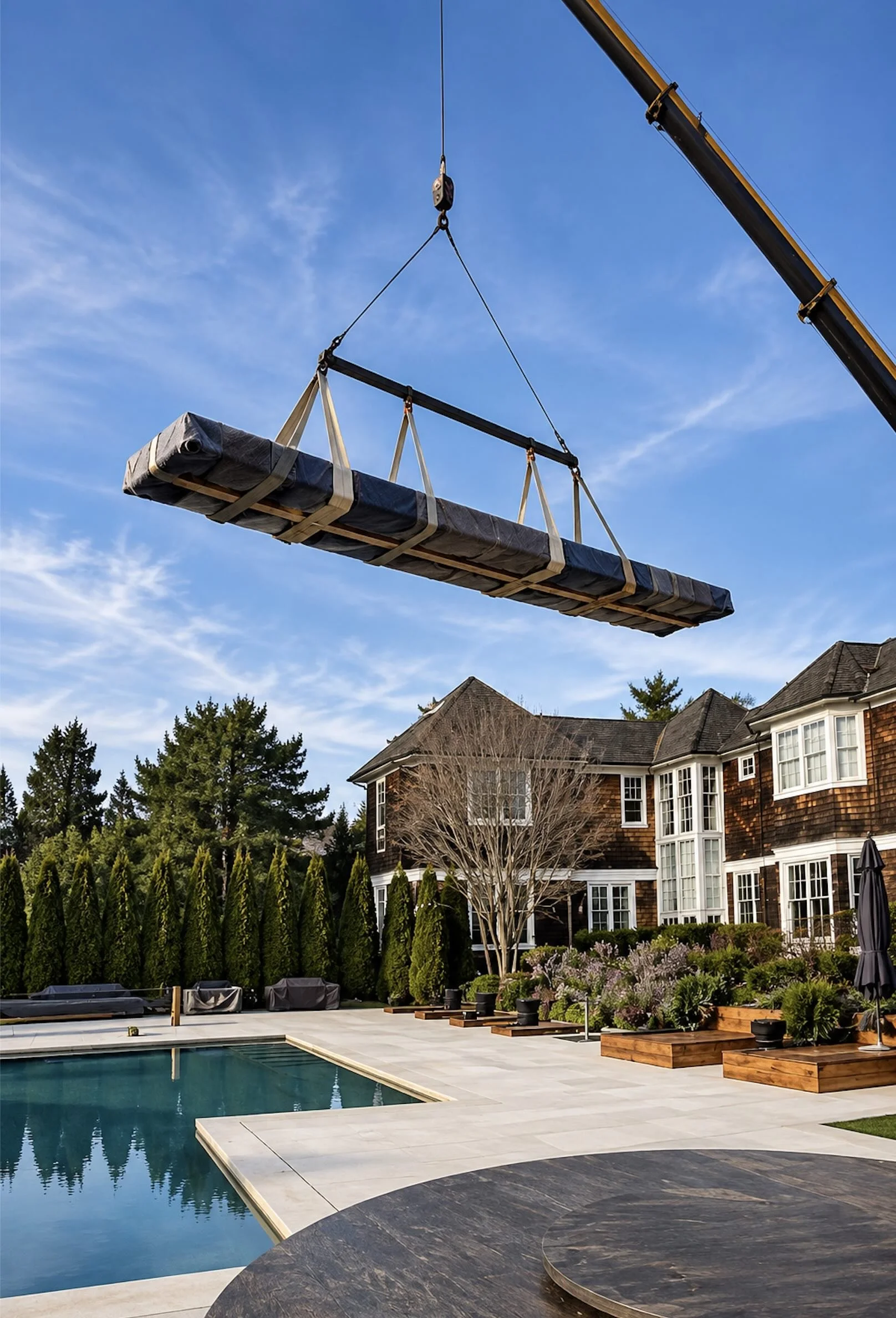
Installing an approximately 25-foot custom table can require more than a furniture dolly. This Hamptons project required crane coordination to safely position the finished table.
How Many People Can Sit at a 25-Foot Table?
A table this long can accommodate a substantial group, but seating capacity depends on more than length.
Chair width, spacing, base placement and the natural contours of the tabletop all affect how many people can sit comfortably.
As a general starting point, I often consider approximately 24 inches of table length per person along each side, then adjust based on the actual chairs and project.
At 25 feet, the objective isn't squeezing the maximum possible number of chairs around the table.
It's creating generous seating that feels appropriate for the scale of the room.
Do You Need a 25-Foot Table?
Probably not.
And that's important.
I specialize in oversized tables, but I don't recommend making a table enormous simply because it's possible.
The table needs to fit the architecture.
For one home, that might mean an eight-foot dining table. For another, 12 or 14 feet may be ideal. A substantial residence, commercial space or boardroom may call for 16, 20 or even 25 feet.
The correct size is the one that feels intentional in the room.
My ability to build at extreme dimensions simply means the fabrication capability doesn't have to dictate the design.
We can start with the space and determine what the space actually needs.
Large Dining Tables and Conference Tables
The same principles that made this 25-foot residential project possible apply to large commercial tables.
I also specialize in extra-large conference and boardroom tables, where lengths of 12, 16, 20 feet or more may be required.
Commercial projects introduce additional considerations such as power, data connections, cable management, seating capacity and installation access.
But the foundation is the same:
Start with exceptional material, understand the room, engineer the structure around the slab and plan installation before construction begins.
Who Builds 20- to 25-Foot Live Edge Tables?
Kristopher Kirkpatrick Custom Furniture specializes in large and extra-large custom live edge dining and conference tables built from premium wood slabs.
I work from my workshop in Valley Center, California, with a particular focus on exceptional Claro walnut and Bastogne walnut.
Projects range from conventional custom dining tables to 12-, 16-, 20-foot and larger pieces, including this approximately 25-foot Claro walnut table built for the Hamptons.
I serve clients throughout San Diego, Orange County, Palm Springs and Los Angeles and build custom tables for projects throughout California and nationwide.
Commissioning an Oversized Custom Table
If you're considering an extra-large dining or conference table, start with the space.
Send me the room dimensions, desired seating capacity, location and any architectural plans or photographs available.
From there, I can help determine appropriate dimensions, identify available slabs and develop a design around both the wood and the architecture.
Whether the project calls for 12 feet, 16 feet, 20 feet or something truly extraordinary, the process starts by finding the right material.
Kristopher Kirkpatrick Custom Furniture — specializing in large and extra-large custom live edge dining and conference tables handcrafted from premium slabs in Valley Center, California for clients throughout Southern California and nationwide.