
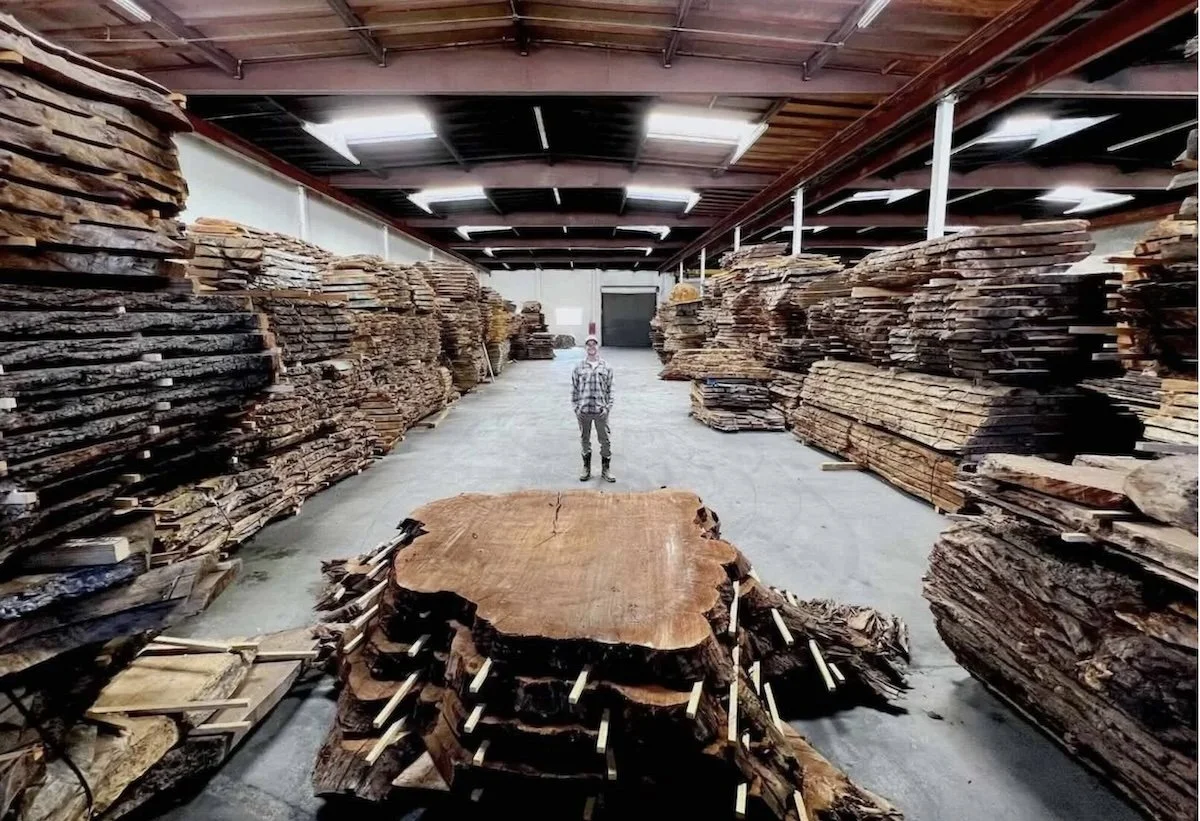
How Big Can a Live Edge Dining Table Be? A Guide to 12-, 16- & 20-Foot Tables
How big can a live edge dining table actually be?
The short answer is: much larger than most people realize.
I've built custom tables at 12, 16, 20 feet and beyond, including an approximately 25-foot Claro walnut table for a residential project in the Hamptons.
At those dimensions, however, building a table is no longer simply a matter of making a standard dining table longer.
Finding an exceptional slab, determining the proper width, engineering the base, accounting for hundreds of pounds of solid wood and figuring out how the finished table will get into the property all become part of the design.
At Kristopher Kirkpatrick Custom Furniture in Valley Center, California, I specialize in large and extra-large custom dining and conference tables made from premium wood slabs, particularly Claro and Bastogne walnut.
If you're considering a 12-, 16-, 20-foot or larger table, here's what you need to know.
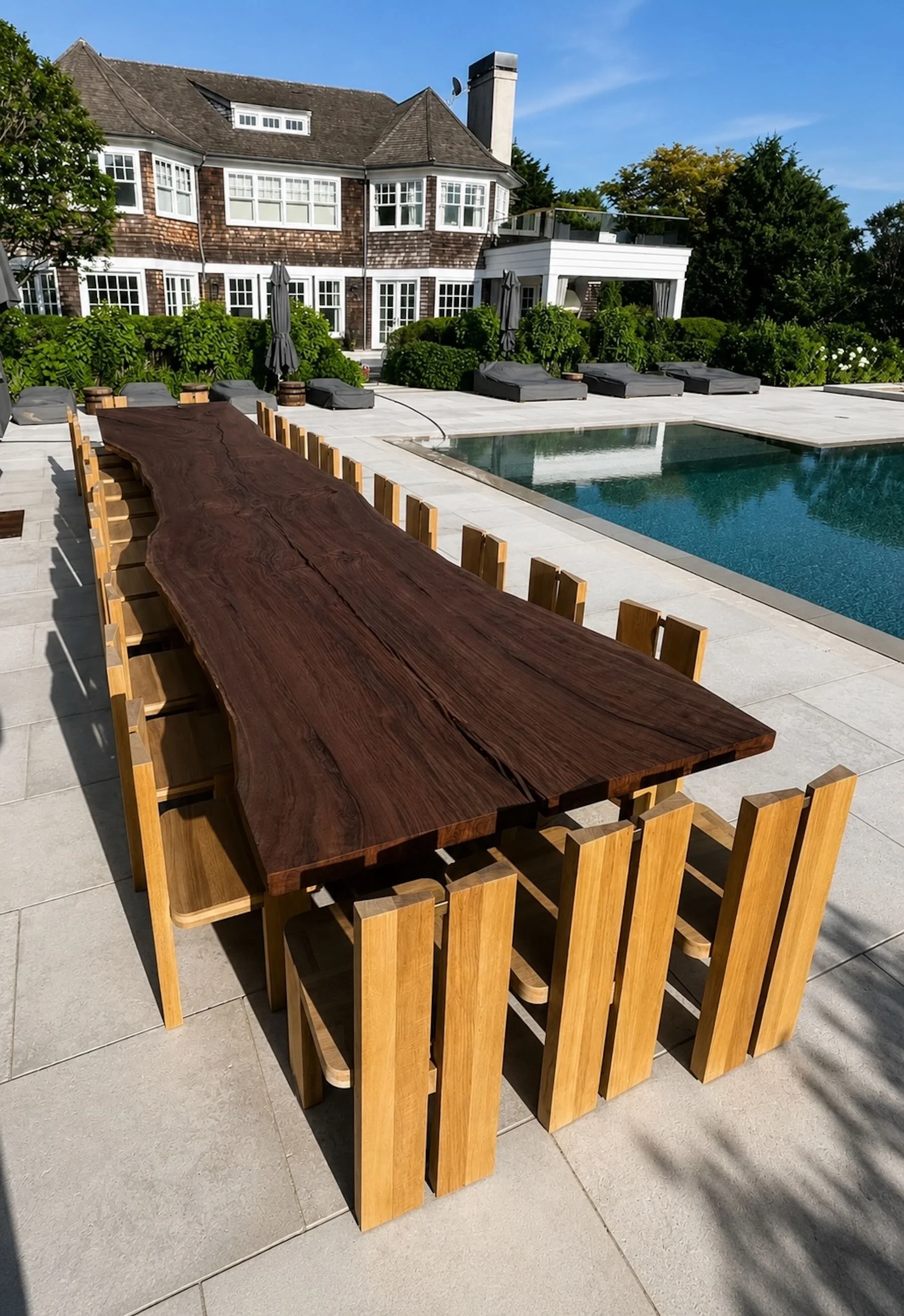
Approximately 25 feet long, this custom Claro walnut live edge table demonstrates the scale possible when exceptional slabs and specialized large-format fabrication come together.
An approximately 25-foot Claro walnut live edge table built for a residential project in the Hamptons.
Is There a Maximum Size for a Live Edge Table?
There isn't a universal maximum.
Instead, four things usually determine how large a custom live edge table can realistically be:
The available slab.
The larger the table becomes, the more difficult it is to find a single piece of furniture-grade wood with sufficient length, width, thickness and stability.
The room.
A table needs enough space around it for chairs, circulation and comfortable use. Just because a 20-foot table physically fits inside a room doesn't necessarily mean it belongs there.
The structure.
Large solid-wood slabs can weigh hundreds of pounds. The base needs to properly support the top while still allowing for the natural seasonal movement of solid wood.
The installation.
Doors, hallways, elevators, stairs and access to the property can ultimately determine what's possible.
For very large projects, I consider all four before settling on the final dimensions.
What Size Table Do You Need?
For most residential projects, the first question isn't “How large can we make it?”
It's:
“How many people do you want to seat comfortably?”
A conventional dining table may only need to accommodate six to ten people. Once you're trying to seat 14, 16, 20 or more, the dimensions change substantially.
As a general starting point, I like to allow approximately 24 inches of table length per person along each side, although comfortable spacing can increase depending on the chairs, place settings and overall design.
A 12-foot table, for example, can often seat approximately 14 people with six along each side and one at each end.
Larger tables can accommodate substantially more, but seating capacity shouldn't be calculated from length alone. Width, chair size, base placement and how the ends of the table are shaped all matter.
That's why I design large tables around the actual room and intended seating arrangement rather than relying solely on a generic size chart.
12-Foot Live Edge Dining Tables
A 12-foot custom dining table is large, but it can still work beautifully in a substantial residential dining room.
This size is particularly useful for clients who entertain frequently or have large families but don't necessarily need a monumental table.
At 12 feet, there are also more slab options available than there are at extreme dimensions.
A premium single slab may be possible, depending on the desired width and species, or two carefully selected slabs can be used when appropriate.
For many large residential projects, 12 feet is an excellent balance between impressive scale and everyday usability.
16-Foot Live Edge Tables
At approximately 16 feet, the table begins entering a different category.
Material becomes more difficult to source, weight increases considerably and base engineering becomes more important.
A 16-foot live edge dining table can become the architectural centerpiece of a large dining room, great room or entertainment space.
This is also a common range where residential and commercial applications begin to overlap.
A table of this size could work equally well in a large private residence, winery, hospitality space or executive conference room.
With premium Claro or Bastogne walnut, a single slab at these dimensions can be extraordinary—but finding the right one takes patience and access to exceptional material.
20-Foot and Larger Live Edge Tables
Once a table reaches approximately 20 feet, we're firmly into specialized fabrication.
Very few trees produce furniture-grade slabs with the combination of length, width, thickness and character required for a table of this scale.
And finding the slab is only the beginning.
The material needs to be transported, surfaced, stabilized, shaped, finished, supported and eventually installed.
This is the type of work I particularly enjoy.
I've spent years developing relationships with slab suppliers and building my shop around the ability to work with unusually large pieces of wood.
That allows me to take on projects that go well beyond conventional dining-table dimensions.
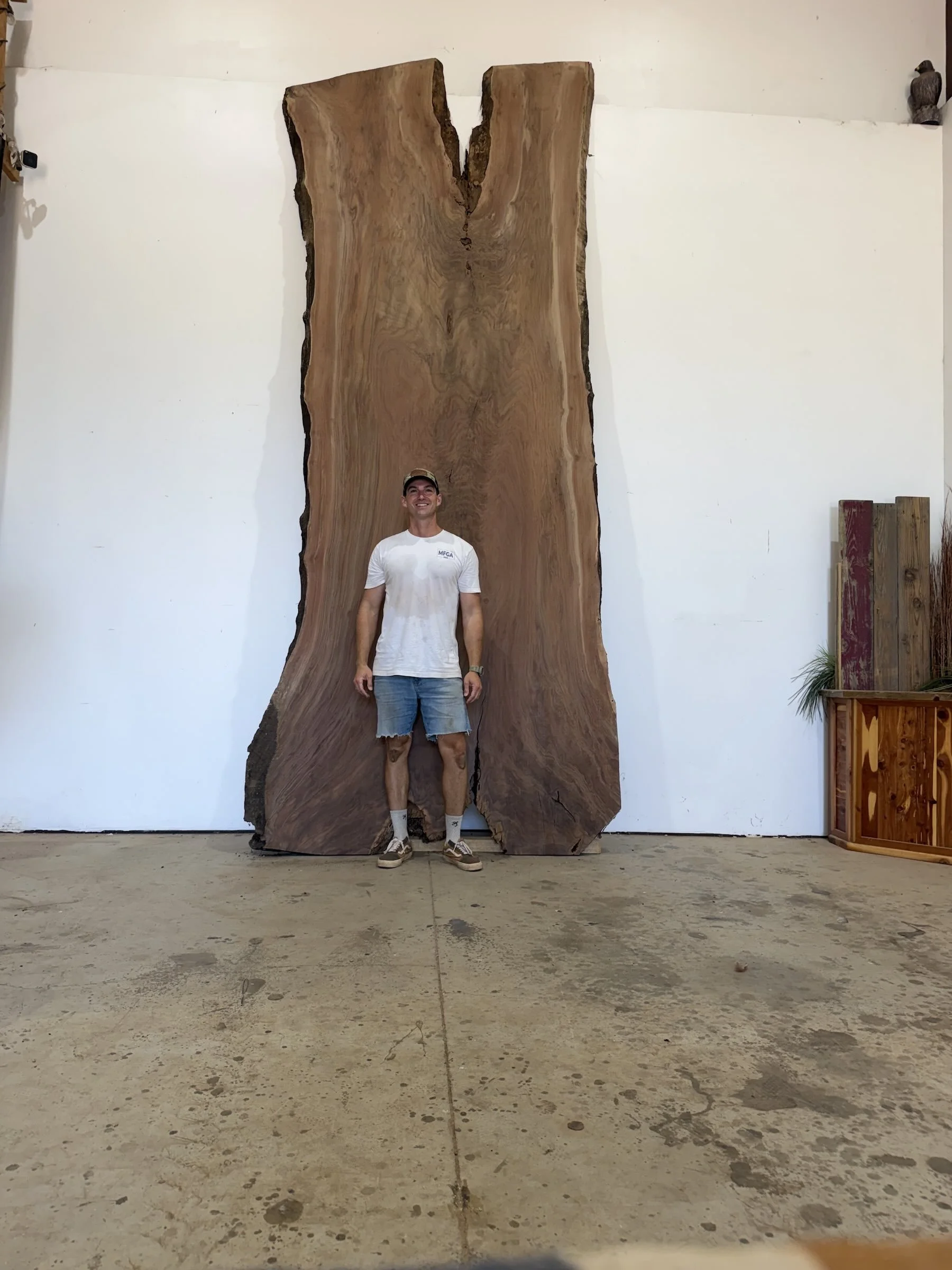
Extra-large live edge slabs require specialized sourcing and fabrication. Material at this scale can become a one-of-a-kind oversized dining or conference table.
[PHOTO 2 — YOU STANDING BESIDE AN ENORMOUS RAW CLARO OR BASTOGNE SLAB]
Extra-large Claro and Bastogne walnut slabs can make extraordinary dining and conference tables, but material of this size requires specialized sourcing and fabrication.
A 25-Foot Claro Walnut Table
One of the largest residential tables I've built was an approximately 25-foot Claro walnut table for a property in the Hamptons.
At that scale, the table becomes more than furniture.
The slab itself becomes part of the architecture.
Projects like this demonstrate why I believe the individual piece of wood should help determine the design. You don't start with an extraordinary slab like this and force it into a generic furniture plan.
You build around what the tree gives you.
Large projects also require planning far beyond the woodworking itself. Transportation, access, installation and the equipment required to safely handle the finished piece all have to be considered from the beginning.
Single-Slab vs. Multi-Slab Tables
Many clients looking for an oversized table initially want a single slab.
I understand why.
There's something remarkable about seeing the grain from one tree run continuously across an enormous tabletop.
When exceptional single slabs are available, they're difficult to beat.
But a single slab isn't automatically the best solution for every large table.
Two carefully selected slabs can create greater width, provide different design opportunities and sometimes make an extremely large project more practical.
The decision should be based on the available material and the desired result—not on an arbitrary rule that one construction method is always superior.
Width Matters Just as Much as Length
When people talk about large tables, length gets most of the attention.
But width is equally important.
A very long table that is too narrow can feel disproportionate. Conversely, an extremely wide table can make conversation difficult and take up unnecessary room.
For substantial dining tables, the right width depends on the scale of the room, seating configuration and the slab itself.
Width also becomes particularly interesting with large live edge slabs because the natural contours of the tree may vary significantly from one end to the other.
That's part of the appeal.
Instead of forcing the slab into a perfectly uniform rectangle, I can preserve some of that natural movement while still making the finished table functional.
Large Tables Need the Right Base
A massive slab deserves a base designed specifically for it.
The base needs to support the weight of the tabletop, control excessive deflection and provide stability without restricting the natural movement of solid wood.
It also needs to stay out of the way.
On a long dining table, poorly positioned legs can interfere with chairs and reduce usable seating even when the tabletop itself is enormous.
That's why I determine base position and structure around the actual slab dimensions and seating plan.
Depending on the project, that may mean steel, substantial wood bases or a completely custom structure.
Can an Extra-Large Table Be Shipped Across the Country?
Yes.
My workshop is in Valley Center in San Diego County, but large custom tables aren't limited to Southern California clients.
I've built and delivered pieces for projects throughout California and across the country.
For distant projects, the delivery strategy is considered during the design process. Depending on the table, that may involve removable bases, sectional construction, custom crating, freight transportation or specialized installation.
The important thing is to address those constraints before the table is built.
A beautiful 20-foot table isn't very useful if nobody considered whether it can get into the building.
What Is the Best Wood for a Huge Live Edge Table?
For oversized statement pieces, I particularly like Claro walnut and Bastogne walnut.
Both can offer extraordinary color, figure and natural character, and exceptional trees can produce the substantial slabs required for large-format furniture.
I also work with white oak, figured maple, redwood and other species when they're appropriate for the project.
At extreme dimensions, however, species isn't the only consideration.
The individual slab matters more.
It needs to have the right dimensions, moisture content, structural integrity, grain and visual character for the table we're trying to create.
That's why sourcing is such an important part of my work.
Who Specializes in Extra-Large Live Edge Tables?
Kristopher Kirkpatrick Custom Furniture specializes in large and extra-large custom live edge dining and conference tables made from premium wood slabs.
I build each piece at my workshop in Valley Center, California, with a particular focus on exceptional Claro walnut and Bastogne walnut.
Projects can range from substantial residential dining tables to oversized conference tables and one-of-a-kind pieces approaching 25 feet in length.
I work with clients throughout San Diego, Orange County, Palm Springs and Los Angeles, as well as designers, builders and clients elsewhere in California and nationwide.
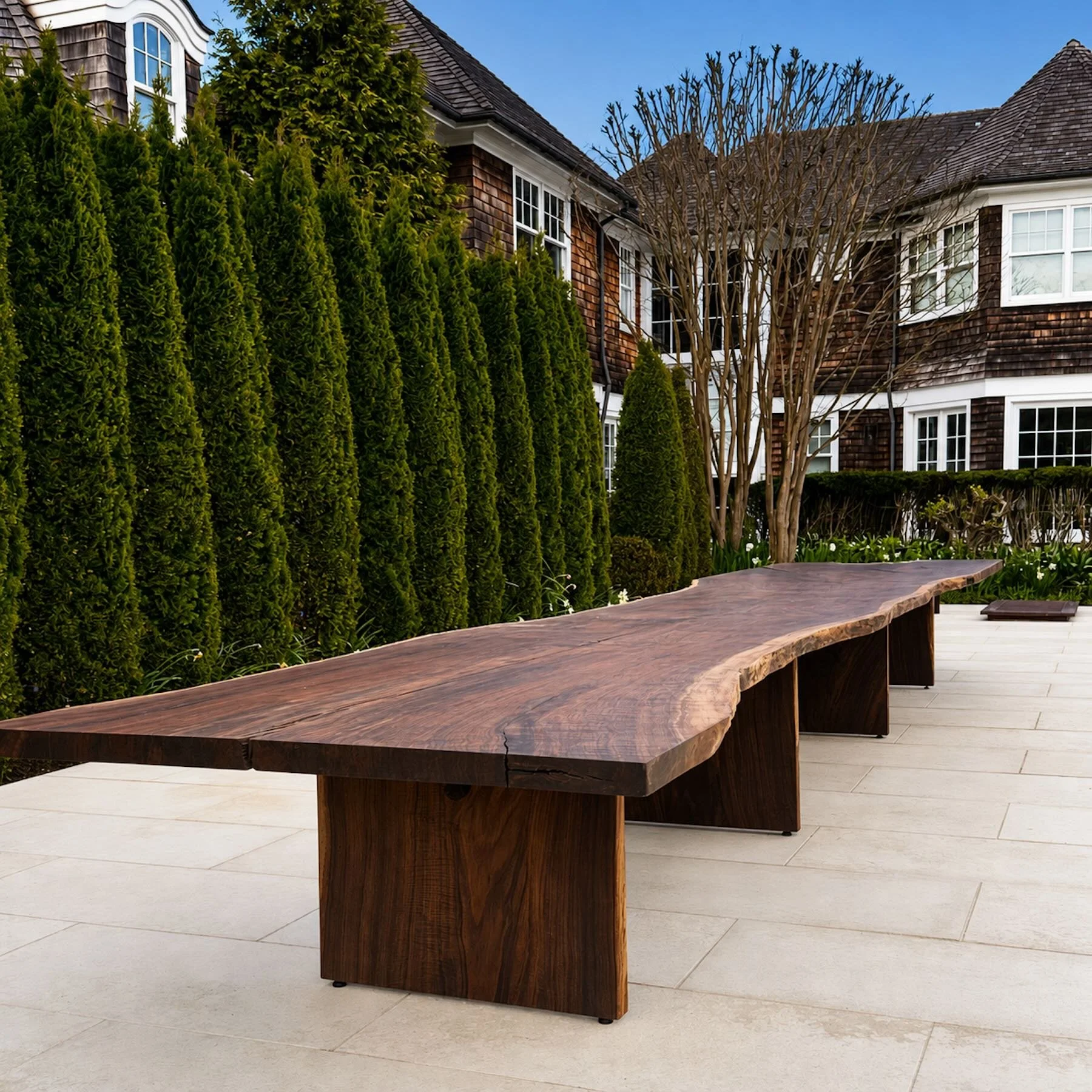
Approximately 25 feet long, this custom Claro walnut live edge table was built for a residential project in the Hamptons.
An oversized custom walnut table turns an exceptional slab into a functional architectural centerpiece.
Planning a 12-, 16-, 20-Foot or Larger Table?
Start with the room.
Send me the dimensions of the space, approximately how many people you'd like to seat and any photos or architectural plans you have available.
From there, I can recommend appropriate dimensions and begin looking at available slabs.
For especially large projects, I can source premium oversized material and design the table around both the individual slab and the architecture.
If you're looking for a 12-foot dining table, 16-foot live edge table, 20-foot conference table or an even larger custom piece, contact me to discuss your project and available slabs.
Kristopher Kirkpatrick Custom Furniture — specializing in large custom live edge dining and conference tables, handcrafted in Valley Center, California for clients throughout Southern California and nationwide.