
How We Flatten Massive Live Edge Wood Slabs with a WoodWizz
Building a beautiful live edge table begins long before the finish is applied.
Before an exceptional slab of Claro walnut, Bastogne walnut or another premium hardwood can become a dining or conference table, the wood must be carefully evaluated, flattened, stabilized and prepared for finishing.
With smaller pieces of lumber, much of this work can be accomplished using conventional woodworking equipment.
But what happens when a slab is 12, 16 or even 20 feet long?
At those dimensions, simply moving the material becomes a challenge, let alone flattening it accurately.
At Kristopher Kirkpatrick Custom Furniture in Valley Center, California, I specialize in building large and extra-large custom live edge dining and conference tables from exceptional hardwood slabs.
One of the most important pieces of equipment in my workshop is my 20-foot WoodWizz slab surfacing and finishing machine, which gives me the ability to work with unusually large material that conventional woodworking equipment cannot accommodate.
Here's a closer look at how massive live edge slabs are flattened—and why proper surfacing is such an important part of building exceptional furniture.
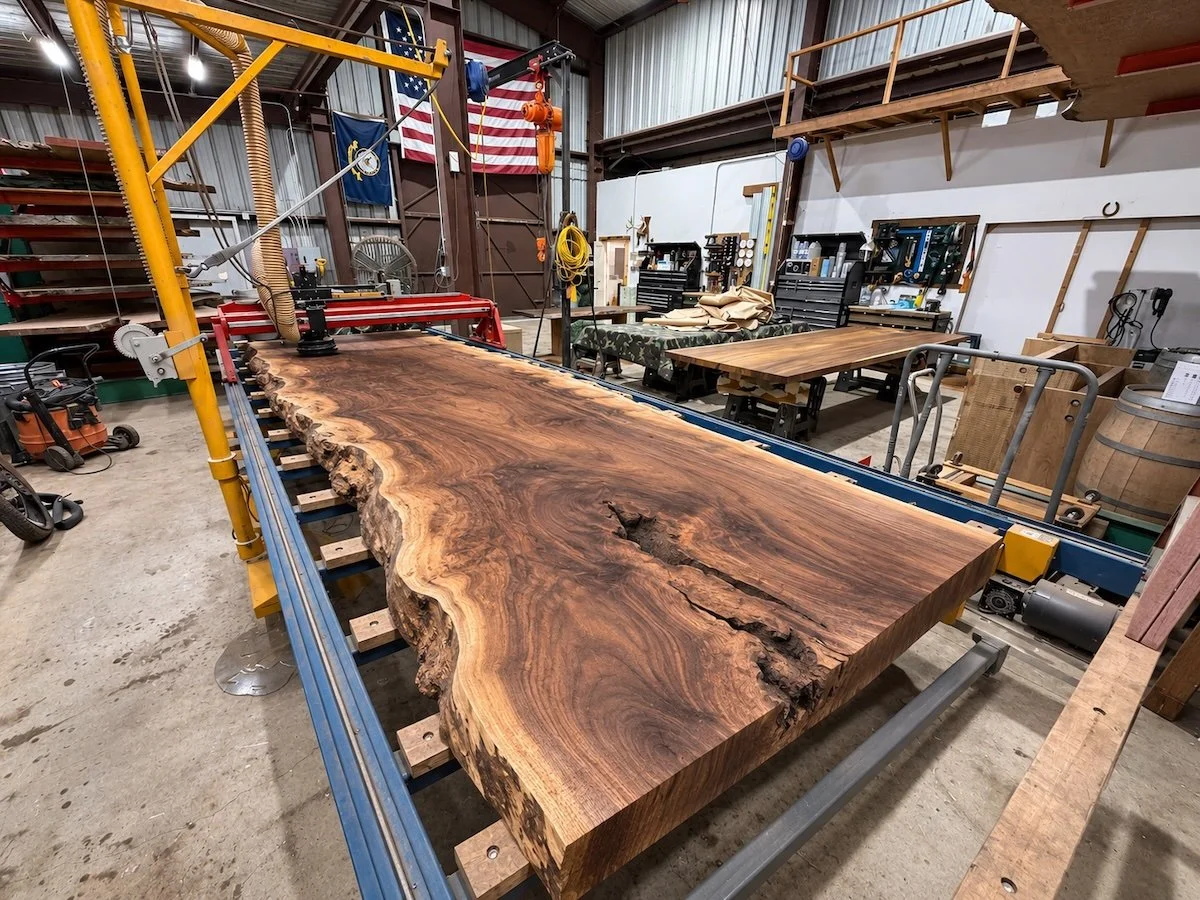
My large-format WoodWizz allows me to flatten and surface exceptionally large hardwood slabs for custom dining and conference tables.
Why Do Live Edge Wood Slabs Need to Be Flattened?
When a tree is milled into slabs, the resulting pieces aren't necessarily flat.
Even with careful milling, natural wood can develop irregularities as it dries.
These may include cupping, twisting, bowing and variations in thickness.
For a dining table, these issues need to be evaluated before the material can be transformed into a finished piece of furniture.
A slab may look relatively flat when sitting on the ground but reveal significant movement or irregularities when placed on a reference surface.
This becomes especially important with wide, oversized slabs.
Flattening establishes a consistent reference surface, allowing the wood to be accurately measured, prepared and fabricated into a tabletop.
But flattening alone isn't a substitute for proper drying or stabilization. The material must be suitable for the intended project before machining begins.
Why Conventional Woodworking Equipment Isn't Always Enough
Most traditional woodworking machinery is designed around boards and panels of relatively manageable dimensions.
A conventional thickness planer, for example, has a fixed opening that limits the width and thickness of material it can process.
That's generally not a problem when working with ordinary lumber.
It's a very different situation when a walnut slab is five feet wide, several inches thick and more than 15 feet long.
At that size, the material may be too large or heavy to pass through conventional equipment.
A router sled can provide an alternative for flattening wide slabs, but smaller setups can become time-consuming when working with exceptionally large pieces.
For serious large-format furniture making, specialized surfacing equipment offers significant advantages.
That's one reason I invested in a WoodWizz.
What Is a WoodWizz Slab Surfacing Machine?
The WoodWizz is a specialized timber surfacing and finishing machine designed to process large wood slabs, burls, tabletops and other substantial pieces of timber.
Rather than feeding the entire slab through a conventional planer, the wood is supported on a flatbed while a cutting head travels across its surface.
The machine allows controlled material removal to establish a flat surface.
Depending on the equipment and setup, the process can also include machine sanding after surfacing.
For large custom tables, this approach provides a practical way to work with material that would otherwise require extensive manual flattening.
My workshop is equipped with a large-format WoodWizz setup extending approximately 20 feet in length.
This capability is particularly valuable when working with the oversized Claro and Bastogne walnut slabs that are central to my business.
How We Flatten a Massive Live Edge Slab
Every slab is different, but my general approach follows several important stages.
Step 1: Evaluate the Material
Before surfacing begins, I inspect the slab to understand what I'm working with.
I look for cracks, voids, knots, unstable areas, signs of movement and other characteristics that may affect machining or the finished table.
Moisture content and the wood's drying history also matter.
With reclaimed or salvaged material, embedded metal and foreign objects can present additional risks and must be checked for before machining.
The goal is to identify problems before they become expensive mistakes.
Step 2: Position and Secure the Slab
Large slabs can weigh hundreds of pounds.
Moving them safely requires careful planning and appropriate material-handling equipment.
Once the slab is positioned on the WoodWizz, it needs to be properly supported and secured.
This step is particularly important when the material has natural twists, irregular edges or uneven thickness.
The slab must remain stable during machining without being forced into an unnatural shape that could distort the result.
Step 3: Establish the First Flat Surface
With the slab secured, the surfacing process begins.
The cutting head removes material from the high points until a consistent reference surface is established.
Depending on the slab's condition, this may require multiple passes.
I generally want to preserve as much thickness as practical while removing enough material to create an accurate surface.
With rare walnut slabs, unnecessary material removal isn't simply wasteful—it can change the appearance and proportions of the finished table.
The objective is precision, not removing more wood than necessary.
Step 4: Surface the Opposite Face
After the first face has been properly surfaced, the slab can be repositioned and the opposite face evaluated.
The newly established surface provides a useful reference for working toward a consistent finished thickness.
The amount of additional material removed depends on the condition of the slab and the requirements of the project.
For an extra-large table, this stage helps establish the dimensions needed for subsequent fabrication.
Step 5: Stabilization, Sanding and Finishing
Flattening is an important step, but it isn't the end of the process.
Natural cracks and voids may still require stabilization or resin work.
The slab must also be shaped, its natural edges refined and the surface progressively sanded.
In my workshop, additional sanding and finishing equipment helps bring the material from a surfaced slab to a refined piece of furniture.
For many of my tables, I use Rubio Monocoat finishes to highlight the natural color and grain of the wood while creating a maintainable surface.
The transformation from rough slab to finished furniture involves multiple stages, each requiring its own attention to detail.
Does Flattening Prevent a Wood Slab from Warping?
This is an important distinction.
Flattening a slab does not permanently prevent natural wood movement.
Wood responds to changes in moisture and humidity.
Even after surfacing, a slab may continue to move if its moisture content changes or if internal stresses are released.
That's why proper drying, material selection, stabilization and construction methods remain essential.
A well-built solid-wood table must accommodate normal seasonal movement rather than attempting to eliminate it entirely.
The WoodWizz provides an accurate surface to work from, but it doesn't replace the judgment required to evaluate the material.
Why Large-Format Surfacing Matters for Oversized Tables
Some of the most extraordinary slabs I work with are exceptionally long, wide and thick.
These pieces can become incredible residential dining tables or monumental conference tables.
But working at that scale requires more than simply owning a large piece of wood.
The workshop needs equipment capable of handling the material throughout the entire fabrication process.
That includes moving, surfacing, stabilizing, sanding and ultimately preparing the tabletop for delivery and installation.
I've completed custom tables exceeding 20 feet in length, including an approximately 25-foot Claro walnut commission for a residence in the Hamptons.
Projects at these dimensions demonstrate why large-format fabrication capabilities matter.
The goal is to take an extraordinary piece of material and transform it into a refined, functional table without sacrificing the natural character that made the slab special.
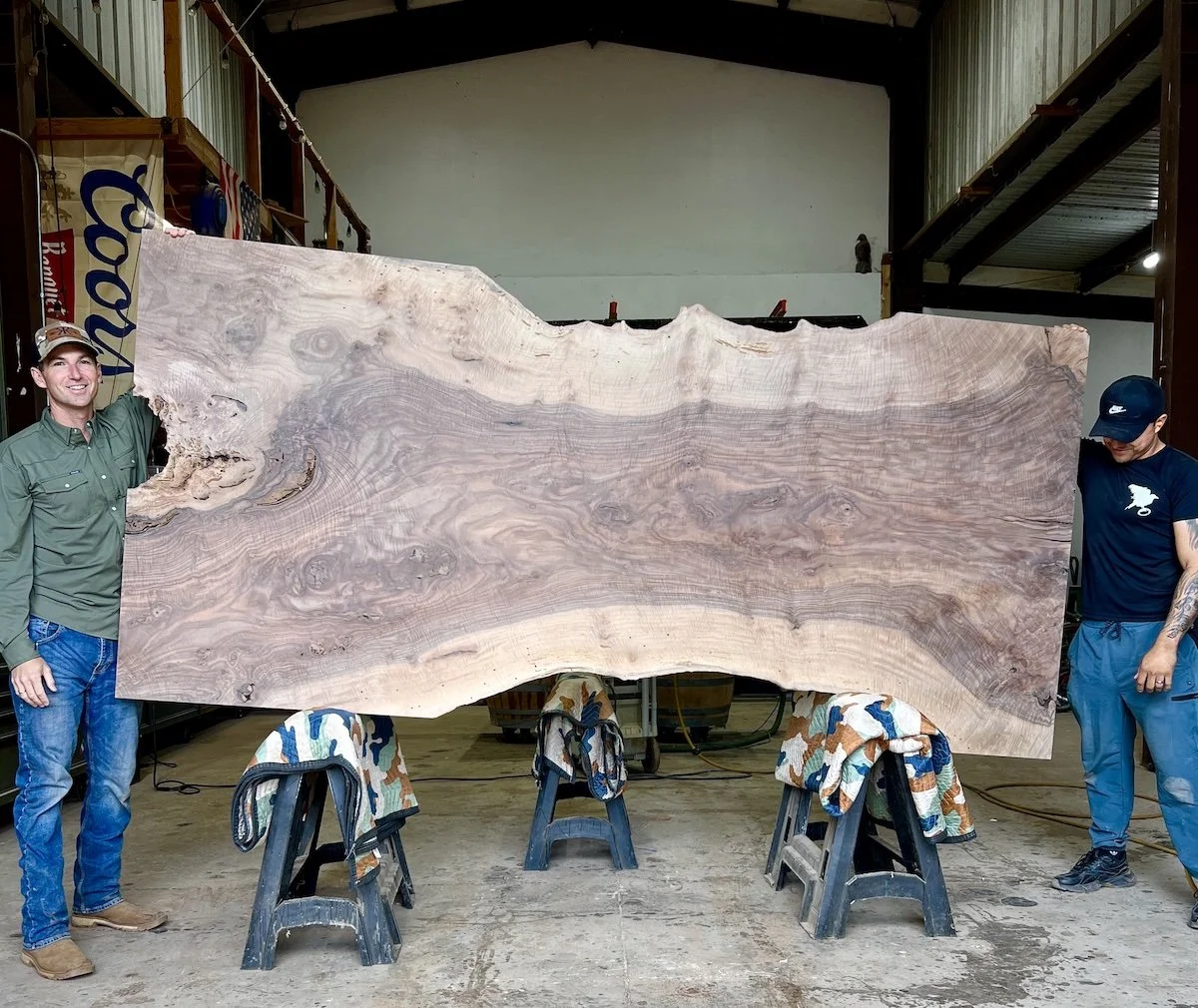
From rough-sawn slab to finished furniture, careful surfacing and preparation help preserve the extraordinary natural character of the wood.
Professional Wood Slab Flattening in San Diego County
Although the primary purpose of my WoodWizz is producing my own custom dining and conference tables, I also offer large wood slab flattening and surfacing services for qualifying outside projects.
This can be useful for local woodworkers, builders, contractors and individuals who have purchased a large slab but don't have the equipment needed to surface it.
Potential projects include:
Large live edge walnut slabs
Rough-sawn hardwood tabletops
Oversized slabs intended for dining tables
Suitable bookmatched or multi-piece tabletops
Other large-format hardwood material requiring surfacing
Each project is evaluated individually.
The slab's dimensions, thickness, moisture condition, existing defects, material composition and required work all influence whether the project is appropriate for the machine.
I don't publish fixed pricing for slab flattening because every piece of wood presents different requirements.
Surfacing quotes are provided on a case-by-case basis after reviewing the material and the requested work.
Where Can You Get a Large Wood Slab Flattened in North County San Diego?
Kristopher Kirkpatrick Custom Furniture offers professional large-format wood slab flattening and surfacing services from my workshop in Valley Center, California, in North County San Diego.
My large-format WoodWizz is particularly useful for projects involving substantial hardwood slabs that are difficult to process with conventional shop equipment.
Services are available by arrangement, subject to the slab's dimensions, condition and the scope of the work.
If you have a large slab that needs flattening, send me photographs, approximate dimensions, wood species and an explanation of the work you're hoping to have completed.
I can then review the project and discuss whether it's suitable for my equipment.
From Raw Slab to One-of-a-Kind Furniture
For me, the appeal of working with extraordinary hardwood slabs goes far beyond their size.
A massive Claro walnut slab may contain grain patterns and natural characteristics that developed over generations.
The challenge is preserving that character while transforming the material into a functional piece of furniture.
Proper slab surfacing is one of the steps that makes that possible.
With the right material, specialized equipment and careful craftsmanship, an enormous rough-sawn slab can become an exceptional custom dining or conference table.
Whether you're commissioning an oversized live edge table or looking for professional slab-flattening services in San Diego County, I'd be happy to discuss your project.
Kristopher Kirkpatrick Custom Furniture — specializing in large custom live edge dining and conference tables, premium walnut slabs, and large-format wood surfacing in Valley Center, California.