
Best Bases for Large Live Edge Tables: Steel vs. Wood
A beautiful live edge slab may be the first thing that catches your attention, but the base beneath it is just as important.
The right table base does more than support the wood. It influences the overall design, seating capacity, stability, visual proportions and long-term performance of the finished piece.
This becomes especially important with large and extra-large live edge dining and conference tables, where a single premium hardwood slab can weigh hundreds of pounds.
At Kristopher Kirkpatrick Custom Furniture, I specialize in building custom tables from exceptional Claro walnut, Bastogne walnut and other premium hardwood slabs, including oversized pieces extending well beyond conventional dining-table dimensions.
From my workshop in Valley Center, California, I've worked with everything from traditional wood trestle bases to contemporary powder-coated steel designs and custom architectural supports.
When choosing a base, I generally begin with three questions:
How large is the slab? What does the room look like? And how will the table be used?
Here's how I approach selecting the right foundation for a custom live edge table.
Why the Table Base Matters More Than You Think
With a conventional dining table, base selection can seem relatively straightforward.
However, as the tabletop becomes longer, wider and heavier, the structural requirements become more demanding.
A large solid-wood table needs sufficient support to limit excessive deflection, maintain stability and accommodate the natural movement of the wood.
The base also needs to provide comfortable legroom and allow chairs to be positioned without interfering with the supports.
And from a design perspective, it should complement the slab rather than compete with it.
An extraordinary piece of Claro walnut deserves a base designed specifically around the wood.
That's why I prefer to select the slab first and develop the base around its dimensions, weight, natural character and intended location.
Steel Table Bases: Modern, Strong and Versatile
Powder-coated steel is one of my favorite materials for contemporary custom tables.
Steel can provide substantial structural strength while allowing for relatively clean, minimal designs.
This makes it particularly well suited to modern homes, executive conference rooms and architectural interiors.
Trapezoid Steel Bases
A custom trapezoid base is an excellent option for many live edge dining tables.
Its angular shape provides a contemporary contrast to the natural curves of the slab.
I particularly like matte black powder-coated steel beneath richly figured walnut because it creates a strong visual relationship between the wood and the base without overwhelming the tabletop.
For large tables, the dimensions, steel sections, connections and placement must be selected to suit the specific top.
Custom Steel Pedestals
For some projects, steel pedestal bases provide a cleaner solution.
Pedestals can create more open seating arrangements by reducing the number of supports near the table's perimeter.
Depending on the design, they can also make a substantial tabletop appear surprisingly light.
However, pedestal bases require careful attention to footprint, stability and attachment details, especially when supporting a wide or unusually long slab.
Why Choose a Steel Base?
Steel is particularly attractive when the project calls for:
Contemporary or industrial architecture
Minimal visual clutter beneath the table
Custom powder-coated finishes
Substantial structural support
Clean lines that contrast with organic live edges
Removable components for transportation and installation
The goal isn't to make the base disappear completely. It's to create the appropriate balance between structural performance and the natural beauty of the wood.
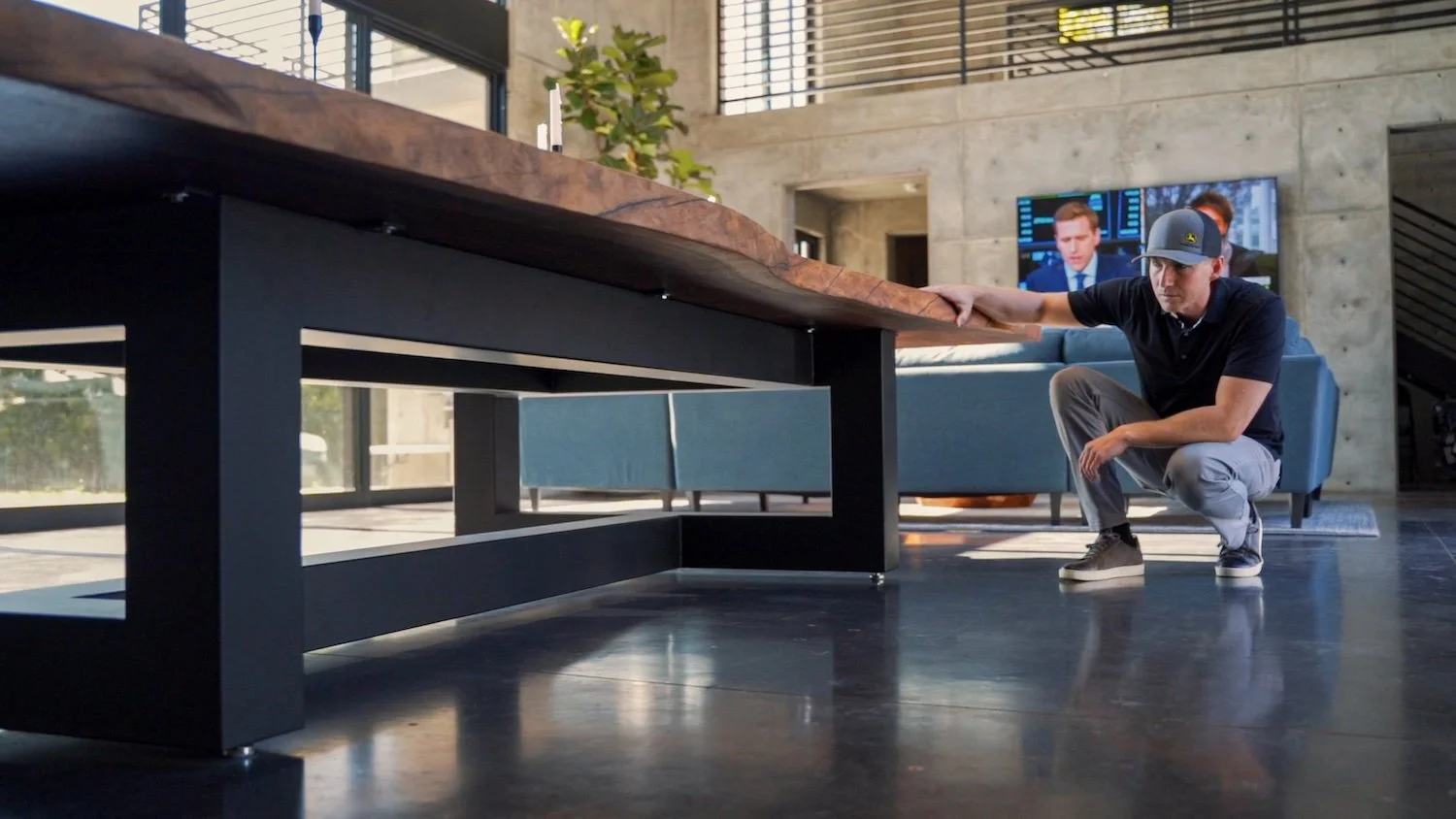
An oversized Claro walnut live edge dining table supported by a custom matte black steel base. The clean, architectural design provides strength and stability while allowing the natural beauty of the walnut slab to remain the focal point.
Wood Trestle Bases: Traditional Craftsmanship and Timeless Design
While steel is an excellent choice for contemporary interiors, I also appreciate the character of a well-designed wood trestle base.
A substantial walnut trestle can make the entire table feel unified, particularly when the base is crafted to complement the color and character of the top.
For large residential dining tables, this approach can create a warm, architectural presence that feels both traditional and refined.
What Is a Trestle Table Base?
A traditional trestle base generally uses two or more supporting structures connected by a stretcher or other structural elements.
Rather than relying on four legs positioned near the corners, the trestles support the tabletop from underneath.
Depending on the proportions, this can create an attractive seating arrangement and allow the base itself to become part of the design.
With an exceptionally large slab, the joinery, proportions and placement need to be carefully considered.
A beautiful trestle base should feel intentional—not like an undersized structure beneath an enormous piece of wood.
When I Recommend Wood
A wood trestle base may be the better choice for clients who want:
A traditional or transitional design
A coordinated solid-wood appearance
A substantial architectural foundation
Visible woodworking and joinery
A warm, timeless aesthetic
Wood bases aren't limited to rustic interiors.
With the right proportions and finishing, a custom walnut trestle can look equally appropriate in a refined contemporary home.
Steel vs. Wood: Which Base Is Better?
Neither material is automatically superior.
The best choice depends on the dimensions of the slab, the architecture of the space and the intended use.
ConsiderationSteel BaseWood BaseAppearanceClean, modern, minimalWarm, traditional or architecturalDesign flexibilityExcellent for slim profiles and custom shapesExcellent for sculptural and substantial formsSeatingCan provide open legroom with proper placementTrestles can provide excellent seating clearanceFinish optionsPowder coating and specialty metal finishesNatural wood, stains and protective finishesConstructionRequires appropriate metal fabrication and connectionsRequires proper woodworking, joinery and supportBest applicationContemporary dining rooms and boardroomsTraditional, transitional and statement interiors
Ultimately, the decision should be based on the entire project rather than appearance alone.
How Do You Support a 12-, 16- or 20-Foot Live Edge Table?
This is where large-format furniture requires a different approach.
A 16-foot solid walnut tabletop may need a substantially different support system than an eight-foot table.
The required structure depends on the thickness, width, weight, stiffness and condition of the slab, as well as the locations of the supports.
A long tabletop can also present challenges with deflection and overall stability.
For exceptionally large pieces, I evaluate the support requirements individually and coordinate additional structural design or engineering when warranted.
A custom base may require multiple supports, reinforced steel components, connecting stretchers or another configuration tailored to the slab.
There is no universal base design that works for every oversized table.
An exceptionally wide Claro walnut slab with irregular natural edges may require a different solution than a narrower conference table of the same length.
This is why the individual material should be considered before finalizing the base.
Allowing Solid Wood to Move Naturally
One of the most important considerations in custom table construction is something many buyers never see:
Solid wood naturally expands and contracts as humidity changes.
Most seasonal movement occurs across the grain rather than along its length.
A large tabletop needs an attachment system that holds it securely while accommodating that movement.
If the wood is rigidly restrained across its width, changes in humidity can create unnecessary stress and increase the risk of cracking, distortion or attachment failure.
Depending on the construction, appropriate solutions can include slotted mounting holes, specialized tabletop fasteners or other movement-accommodating attachment methods.
This principle applies to both steel and wood bases.
A substantial steel support doesn't eliminate the natural movement of a solid-wood slab.
Proper design must account for that movement rather than attempt to prevent it entirely.
Base Placement Can Affect Seating Capacity
A table can be exceptionally long and still provide disappointing seating if the base is positioned incorrectly.
This is particularly important with large dining tables and conference tables.
For a residential table, I consider where chairs will be positioned, how much end overhang is appropriate and whether the supporting structures interfere with legroom.
For large conference tables, seating arrangements may need to accommodate executive chairs, power connections and clear access around the room.
Pedestal and trestle designs can offer advantages in certain layouts, but the support structure still needs to suit the tabletop.
A properly designed base should support the table without compromising how people use it.
Matching the Base to the Architecture
I don't believe every live edge table needs to look rustic.
Some of my favorite projects place extraordinary walnut slabs inside contemporary homes with concrete, glass, steel and restrained architectural finishes.
In those settings, a simple black steel base often provides the contrast needed to let the wood become the focal point.
In a more traditional residence, a custom walnut trestle may create a stronger connection with the surrounding architecture.
The same premium slab could look dramatically different depending on which base it sits on.
That's one of the reasons I prefer building each table specifically for the room rather than relying on a limited collection of predetermined designs.
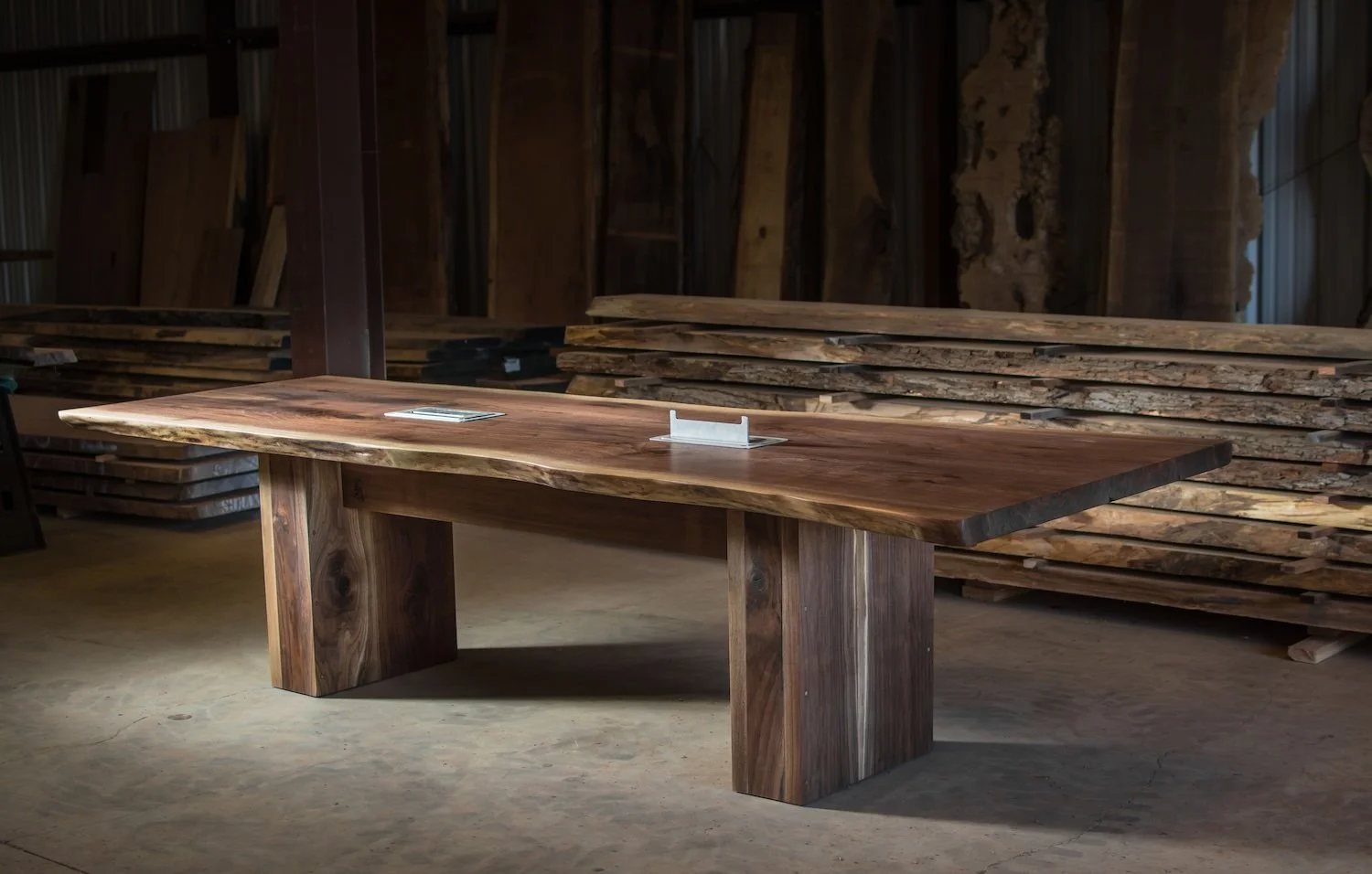
Custom walnut pedestal bases provide a substantial, architectural foundation while complementing the natural character of this live edge conference table.
Does a Custom Table Base Affect the Price?
Absolutely.
The cost of a base depends on its materials, dimensions, fabrication requirements, finish and overall complexity.
A relatively simple powder-coated steel design may be less expensive than an elaborate custom wood trestle.
However, a complex engineered steel structure can also require substantial fabrication and finishing work.
It's important not to assume that steel is always the economical option or that wood is always more expensive.
For oversized tables, the structural requirements can influence the final cost significantly.
I prefer to evaluate the tabletop and base together when preparing a custom quote.
For more information, read my guide to how much a large custom live edge walnut table costs.
Delivery and Installation Matter Too
Large custom tables present logistical challenges that should be addressed during the design phase.
The base may need to be removed for transport, assembled at the destination or designed around limited access to the property.
For substantial residential and commercial projects, I consider doorways, hallways, elevators, stairs and installation equipment before finalizing the design.
This is particularly important for tables extending 14, 16, 20 feet or more.
I've completed exceptionally large projects, including an approximately 25-foot Claro walnut table installed at a residence in the Hamptons.
At that scale, the supporting structure and installation plan become critical elements of the project.
What Is the Best Base for a Large Live Edge Dining Table?
For many contemporary projects, I like a custom powder-coated steel base because it offers design flexibility and a clean visual relationship with the slab.
For more traditional or architectural interiors, a substantial wood trestle can be equally compelling.
But neither is my automatic recommendation.
The best base is the one that properly supports the individual tabletop, accommodates natural wood movement, provides comfortable seating and complements the space.
The slab should determine the base—not the other way around.
Commissioning a Custom Live Edge Table
At Kristopher Kirkpatrick Custom Furniture, I specialize in large and extra-large custom dining and conference tables built from exceptional hardwood slabs.
My work includes rare Claro walnut, Bastogne walnut and other premium materials, with projects ranging from substantial residential dining tables to extraordinary oversized commissions.
Every table is designed around the individual slab, the architecture and the client's requirements.
If you're considering a custom live edge table, I can help with slab selection, dimensions, base design, finishing and delivery planning.
From my workshop in Valley Center, California, I work with clients throughout San Diego, Orange County, Palm Springs and Los Angeles, as well as clients nationwide.
Kristopher Kirkpatrick Custom Furniture — turning extraordinary wood into one-of-a-kind pieces.